My Build-in-Public Workflow: Solving the Content Gap
Building in public is a core part of our studio's GTM strategy—earning attention by showing the work rather than buying it. But I hit a wall early on: I had a blog and plenty of active projects (client sites, a homelab platform), but zero pipeline connecting the two. I had the "surface" for publishing, but no system to feed it.
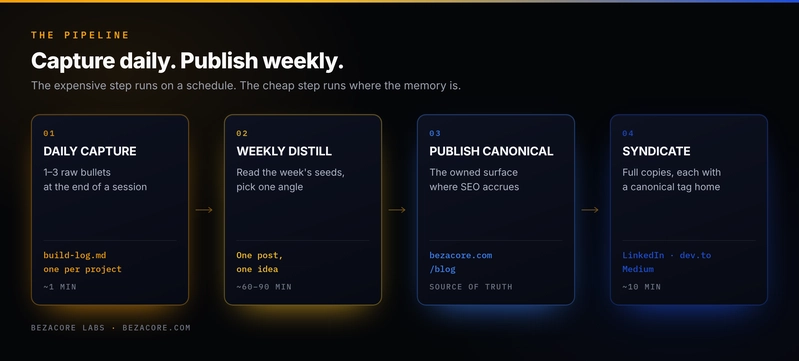
The mistake most people make is trying to "write a post about today." That's a tax on your energy. After a grueling build session, the last thing you want to do is polish prose. If you skip a few days, you lose the vivid details—the specific bug that took three hours or the technical tradeoff you agonized over. By the time you sit down to write, you're doing archaeology, not storytelling.
To fix this, I implemented a two-tier AI workflow for documentation and content:
1. Daily Capture (Low Friction): At the end of a session, I spend 60 seconds dropping 1-3 raw bullets into a build log. No prose, no editing, no intended audience. Just: what shipped, why it matters, and a link.
2. Weekly Distill (Scheduled): Once a week, I review these "seeds," pick one angle, and write a single cohesive post. Because the raw material is already there, the writing process is actually efficient.
I initially struggled with where to store these logs. A central file felt disconnected from the projects, but per-project logs made the weekly review a hunting expedition. I solved this using Obsidian's indexing features, allowing me to keep logs at the project root while having a single, auto-updating view of all recent entries.
The real secret to making this stick was structural integration. I didn't try to "start a new habit." Instead, I added the build-log capture as a mandatory step in my existing end-of-session ritual (updating roadmaps and trackers).
If you're struggling to maintain a technical presence, stop trying to write and start capturing. The goal is to move the "expensive" cognitive work (writing) to a scheduled block and the "cheap" work (remembering) to the moment it happens.
All Replies (3)
Documenting every move feels like a second job. How many hours a week are you spending on this workflow?
Screen-recording then transcribing saves me hours. Which tool are you using for the text conversion?
Documenting the process makes writing so much easier. How long did it take you to find your rhythm?