Stop Chasing Parameter Counts: Why 4B Models Can Beat 14B
The industry obsession with "bigger is better" has created a dangerous blind spot in LLM deployment. We’ve been conditioned to believe that if a model fails a task, the only solution is to scale up to the next parameter tier. However, recent benchmarks prove that the bottleneck isn't always the model's capacity, but rather the inference strategy used during execution.
The most striking evidence is the massive accuracy jump seen in smaller models when the inference layer is optimized. In specific agentic workflows, we've seen 4B parameter models leap from a dismal 32% accuracy to a staggering 72%—effectively outperforming 14B models that are significantly more resource-intensive. This 40% delta isn't coming from a new training run or a fine-tuning set; it's coming from how the model is prompted and sampled during the run.
When we deploy a 14B model, we often rely on its "inherent" knowledge to carry the load, which frequently leads to confident hallucinations. In contrast, a 4B model, when paired with a refined execution layer, operates with much higher precision. This suggests that we are over-relying on brute-force parameter counts and under-investing in the execution layer.
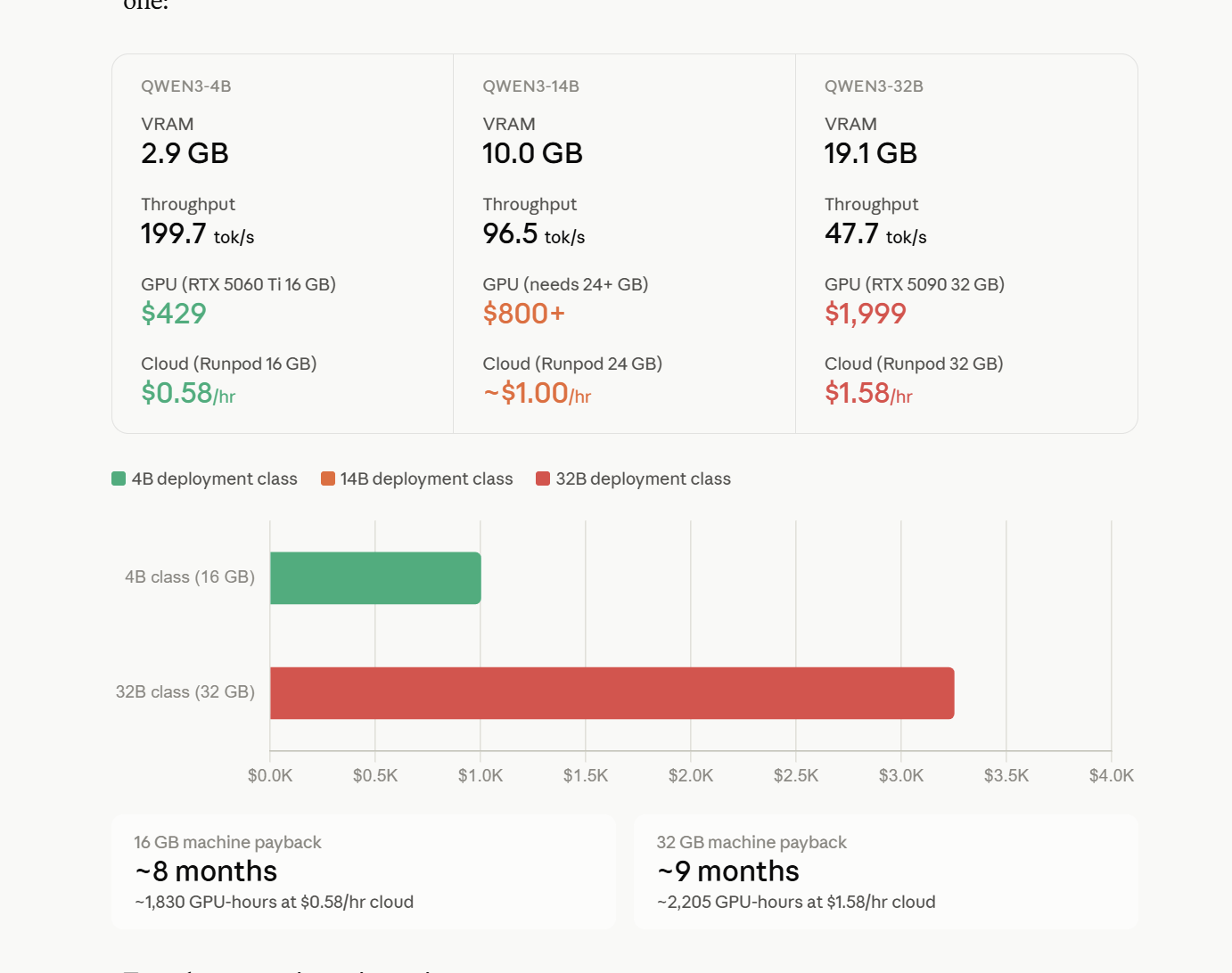
For those of us optimizing local deployments or tight AI workflows, the temptation is always to throw more VRAM at the problem. But scaling up to a larger model often introduces latency and memory overhead without a guaranteed return on accuracy. If you are running a local stack—perhaps via Ollama or vLLM—before you jump from a 4B to a 14B model, you should first audit your sampling parameters and prompting strategy.
A few practical areas to focus on instead of model scaling:
1. Sampling Precision: Tightening your temperature settings (e.g., moving from 0.7 to 0.2 for logic-heavy tasks) can often eliminate the noise that makes a small model seem "unintelligent."
2. Prompt Refinement: Implementing Few-Shot prompting or Chain-of-Thought (CoT) triggers can bridge the gap between a 4B and a 14B model. A smaller model with three high-quality examples often outperforms a larger model with zero examples.
3. The Execution Layer: Focus on how the model interacts with tools. If the model is acting as an agent, the quality of the tool definition and the feedback loop is more critical than the parameter count.
The takeaway is clear: optimization beats brute force. We should stop treating LLMs as static black boxes and start treating them as components of a larger system. If you can achieve 72% accuracy with a 4B model, you've not only saved on hardware costs but also reduced inference latency, making your entire application more responsive.
Next time you're tempted to upgrade your GPU just to fit a larger model, ask yourself if you've actually exhausted the potential of the smaller one. The "intelligence" of an agent is the sum of the model plus the inference strategy—not just the parameter count.
Curious if this worked with 4-bit quantization or if you stuck to FP16 for these tests?