Embeddings: A Beginner's Guide to Vector Space
Mapping Meaning to Coordinates
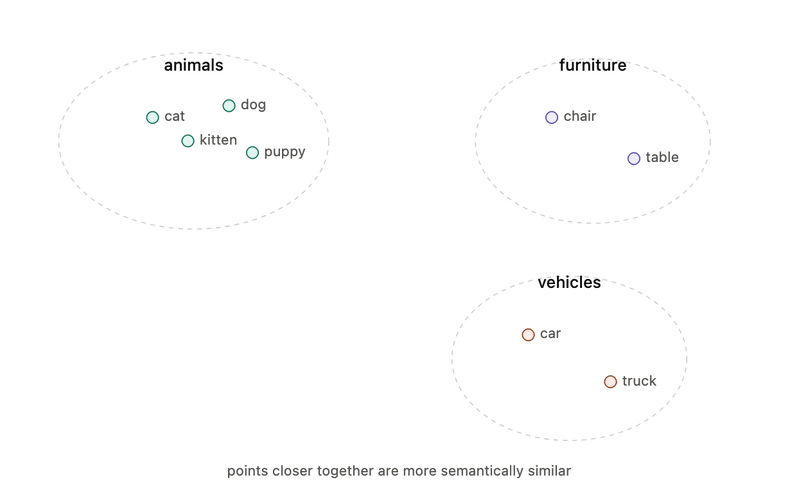
Think of embeddings as a massive, multi-dimensional map. In this space, words with similar meanings are plotted close to one another. While we can visualize this in 2D or 3D, real-world embeddings often operate in hundreds or thousands of dimensions.
The model doesn't have a human assigning coordinates. Instead, during training, it analyzes billions of patterns in language. Because "dog" and "puppy" appear in similar contexts, the model naturally clusters them together, while "truck" is pushed to a completely different region of the map. This allows the AI to capture complex relationships; for instance, the mathematical distance between "king" and "queen" is nearly identical to the distance between "man" and "woman."
Moving Beyond Keyword Search
The real-world utility of this is most obvious when comparing traditional keyword search to semantic search. A keyword system fails if you search for "budget-friendly notebook" but the product is listed as "affordable laptop" because the strings don't match.
An embedding-based AI workflow solves this by:
1. Converting the search query into a vector.
2. Calculating the distance between that vector and the vectors of all stored documents.
3. Retrieving the "nearest neighbors."
This is the fundamental engine behind RAG (Retrieval-Augmented Generation). When you ask a RAG system a question, it embeds your query and pulls the most mathematically similar chunks of data from a vector database to provide context to the LLM.
Practical Application for Devs
If you are building a product that requires grouping content, finding duplicates, or creating a recommendation engine, you should be looking at embeddings rather than string matching. It isn't just for words—images, audio, and entire PDF documents can be embedded into this same vector space.
For anyone starting a deep dive into LLM agents, understanding the distance between these vectors is the first step in mastering how AI actually "retrieves" knowledge.