TypeScript Recursive Types: A Deep Dive
any for nested JSON or file trees. The real power of TypeScript is its ability to model self-referencing structures, allowing the compiler to track type safety at arbitrary depths. If you're manually typing nested config objects and hitting undefined errors at runtime, you're missing out on recursive type definitions.Modeling Nested Data from Scratch
The most practical application is a JSONValue type. Instead of guessing the depth of an API response, you can define a type that references itself. This forces the compiler to validate every level of the object path.
type JSONValue =
  | string
  | number
  | boolean
  | null
  | { [key: string]: JSONValue }
  | JSONValue[];
In this snippet, the base cases are the primitives (string, number, etc.). Without these, the compiler would spiral into infinite expansion. By defining the object and array properties as JSONValue, the type system can now traverse a JSON tree of any depth.
Handling Deep Partials in Production
A common pain point in large-scale AI workflows or configuration management is updating a deeply nested object without losing type safety. A standard Partial<T> only goes one level deep. To fix this, you need a recursive utility type.
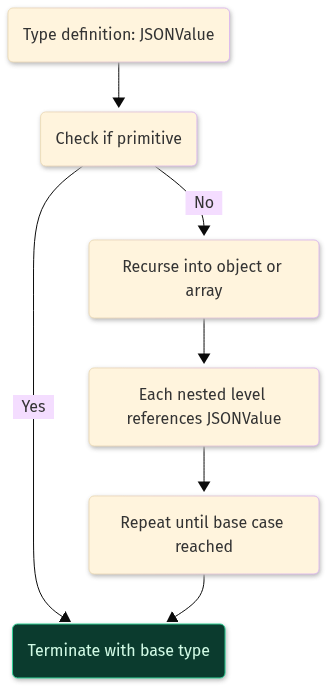
Here is a production-ready DeepPartial implementation:
type DeepPartial<T> = T extends object
  ? { [P in keyof T]?: DeepPartial<T[P]> }
  : T;
This uses a distributive conditional type. It checks if T is an object; if so, it maps over the keys and recursively applies DeepPartial to the values. If it hits a primitive, it stops.

Avoiding the Recursion Limit
TypeScript 5.6+ generally handles recursion up to about 50 iterations. While this sounds like a lot, complex conditional types can trigger "Type instantiation is excessively deep" errors. To prevent this:
- Define explicit base cases: Always ensure your type can resolve to a primitive or
unknown. - Use tail-recursive patterns: Structure your conditional types to flatten evaluations.
- Avoid overly complex mapped types inside the recursion if a simpler interface will suffice.

By implementing these patterns, you move the validation from brittle runtime checks to the compile phase, which is exactly where it belongs for a rigorous development workflow.