SVM Math: Why the Margin Actually Matters
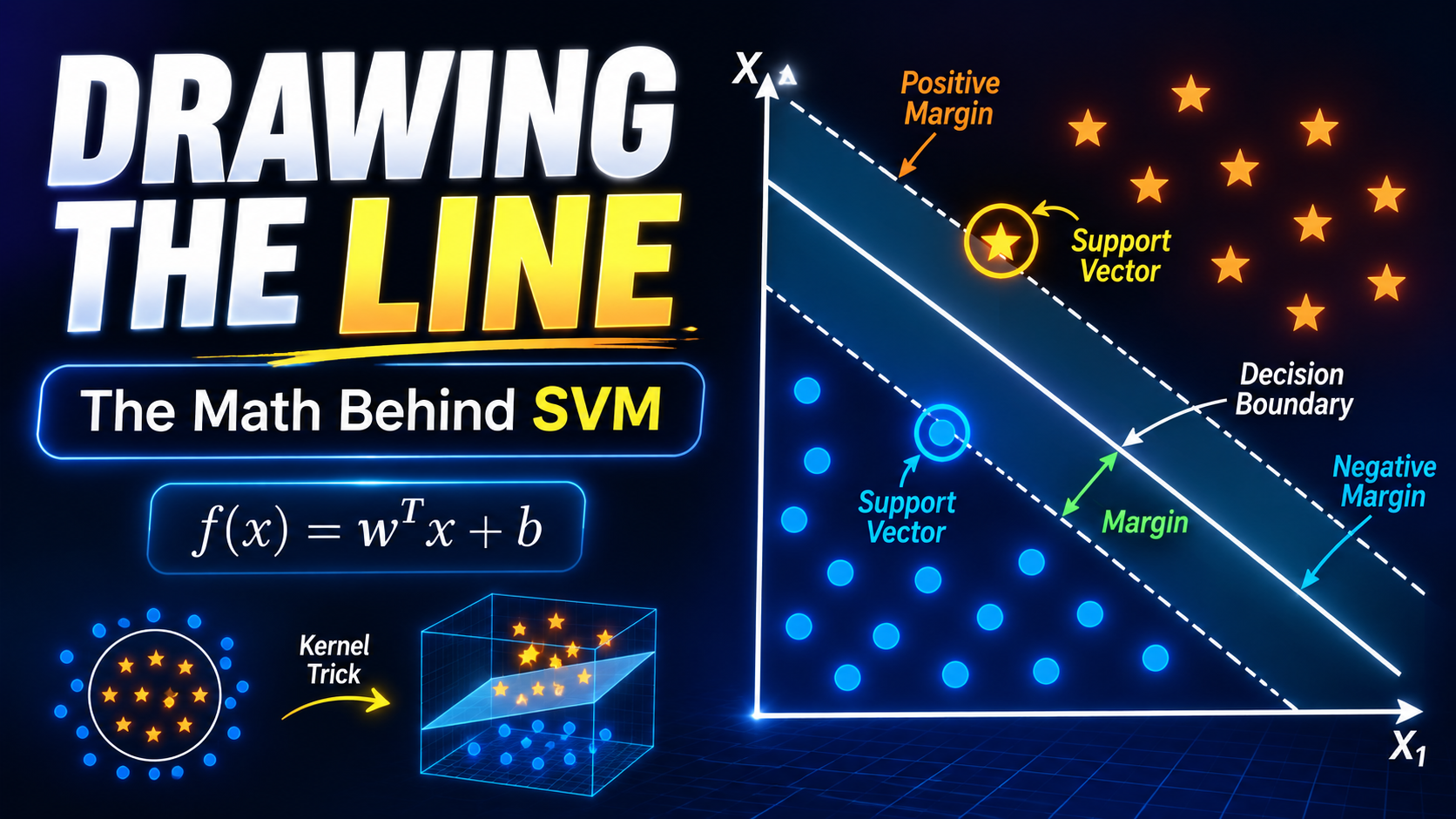
The real magic happens when the data isn't linearly separable. Instead of struggling with a 2D plane, the "kernel trick" projects the data into a higher-dimensional space where a linear split becomes possible. For example, using a Radial Basis Function (RBF) kernel allows the model to create non-linear decision boundaries by effectively calculating the distance between points in an infinite-dimensional space without ever actually computing the coordinates of that space.
I ran into a common issue while testing this on a custom dataset where the model was completely overfitting. My decision boundary was zig-zagging wildly to capture every single outlier.
The diagnosis came down to the $C$ parameter (the regularization penalty). In my config:
svm_params:
  kernel: 'rbf'
  C: 1000  # Too high
  gamma: 'scale'
A $C$ value that is too high forces the model to classify every training example correctly, leading to a narrow margin and poor generalization. By dropping $C$ to 1.0, I allowed for some misclassifications in exchange for a wider, more robust margin. This is the classic bias-variance tradeoff in a real-world AI workflow.
If you are building a custom LLM agent or a data pipeline that requires hard classification boundaries, understanding this geometric approach is more useful than just calling .fit() and .predict().