Choosing the correct
Selecting the wrong tier leads to either paying for unnecessary computational power or hitting limitations that break application reliability. The three tiers offer distinct trade-offs:
- GPT-5.6 Sol prioritizes deep reasoning and peak intelligence, making it suitable for demanding research or autonomous agent tasks where precision is critical.
- GPT-5.6 Terra strikes a balance between capability and latency, delivering robust performance for production applications and enterprise assistants without sacrificing responsiveness.
- GPT-5.6 Luna is engineered for cost efficiency and scalability, delivering acceptable results for basic interactions, simple classification, or high-throughput data processing.
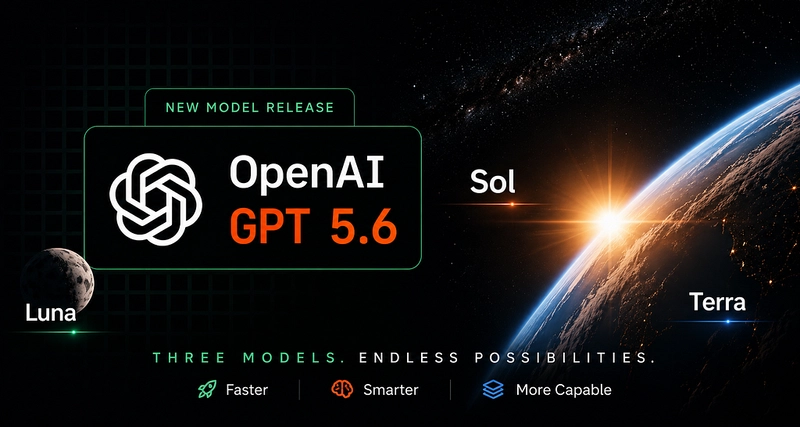
Each tier includes a Pro variant, which allocates additional compute during inference to enhance logical consistency and extend planning depth. Sol Pro stands out for tasks requiring extended deliberation, such as intricate engineering workflows.
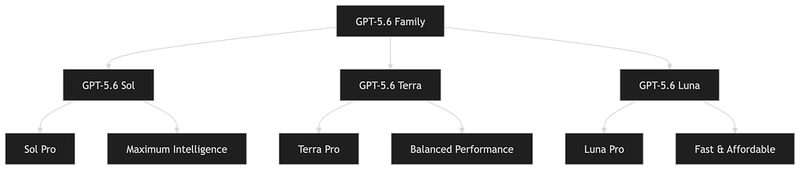
The right choice depends on the application’s requirements:
- For complex coding or architectural decisions, Sol Pro mitigates hallucination risks by allowing deeper analysis of large codebases.
- Terra handles customer-facing interactions smoothly, ensuring nuanced responses without noticeable delays.
- Luna remains viable for routine automation, maintaining output quality while controlling API expenses.
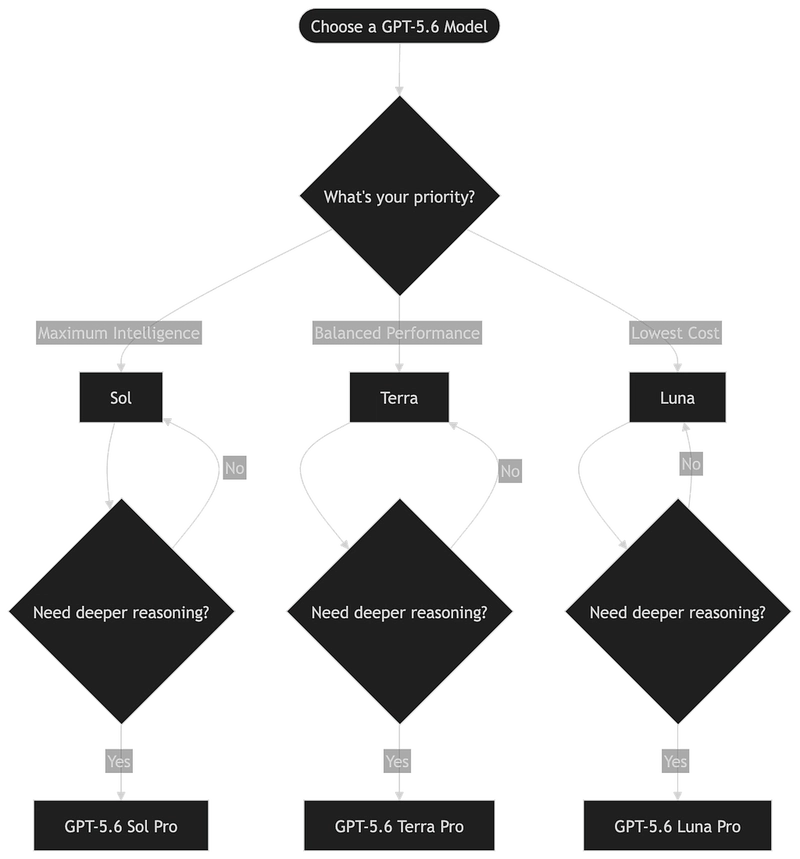
This modular structure enables dynamic request routing. Luna can pre-filter user intent before escalating to Sol only when deeper reasoning is needed, optimizing the cost-performance trade-off in AI agent workflows.
All Replies (3)
Want a live back-and-forth? Join the global AI chat room — login to talk.
Luna’s latency for coding is a game changer. Has anyone benchmarked it against Sol for Python? Users must now select models based on the specific trade-offs between cost, latency, and reasoning depth.
Sol's reasoning is shockingly sharper than the old one-size-fits-all flagship for data tasks. Has anyone else seen this jump in quality? A practical first step is to select a model based on the specific trade-offs between cost, latency, and reasoning depth.
Curious if Terra actually handles long context windows better or if it's just a speed boost. To get a better sense of this, I'd like to see a comparison of the context window size for Terra and Sol, as the latter is designed for complex reasoning and may be able to handle longer context windows.