Nvidia's open-source Personal AI Router (PAIR) turns a home network into a local cluster for AI inference.
Why Agentic Workflows Strain a Single GPU
Running agentic workflows locally often hits a wall: chaining multiple LLM agents eventually exhausts available memory. PAIR solves this by discovering compatible hardware across the local network and synchronizing it to handle inference tasks. It is a software layer, not physical networking hardware, and works alongside tools like Ollama or LM Studio that already manage local models.
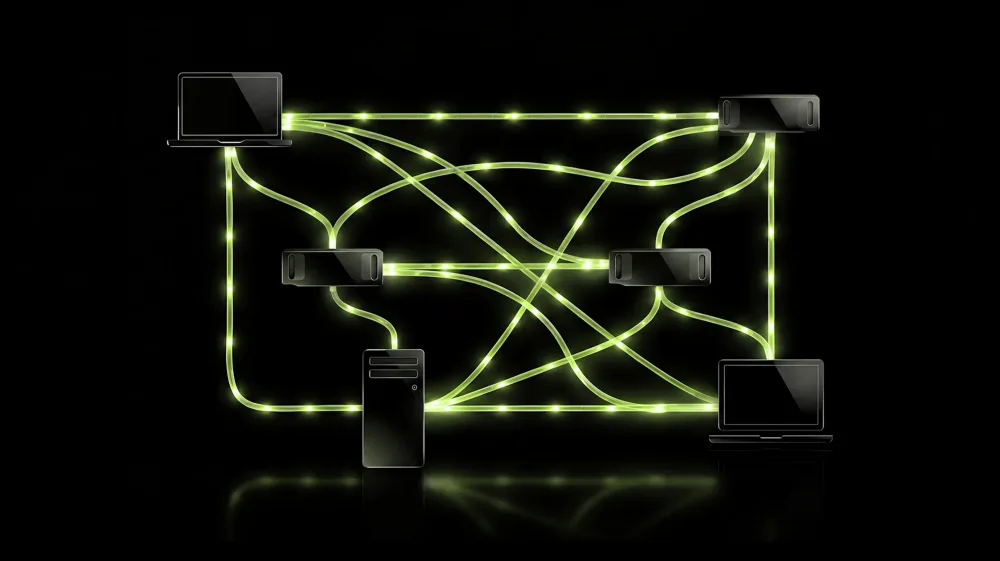
PAIR's main appeal is resource aggregation. A primary workstation, an older gaming rig, or a secondary build in another room all contain idle GPUs that otherwise waste computing power. Before PAIR, a model exceeding a primary card's VRAM left users with no choice but to buy a new, higher-tier GPU. Now, computational work can be routed across multiple machines, turning the local network into a unified resource pool that increases available memory so larger models can be loaded and run without crashing a single machine.
How Distributed Resources Break the VRAM Barrier
This matters especially for the growing use of agentic workflows. A mid-sized model may fit comfortably in VRAM for a single prompt, but memory overhead rises sharply when multiple LLM agents are chained—some planning, others executing, and a third critiquing. The system must then juggle multiple contexts and potentially different model weights at once.
PAIR's "mini-datacenter" approach helps here: instead of overloading one GPU, it spreads inference tasks across compatible hardware discovered on the network, preventing the agentic chain from failing with an "out of memory" error.
As an open-source project, PAIR integrates with the existing local AI ecosystem. It does not replace the backends that load models; it acts as an intelligent traffic controller. When Ollama or LM Studio already manages local models, PAIR works on top of those services. It finds network machines with enough available headroom and directs requests to the right hardware. There is no need to manually assemble complex clusters or write custom distribution scripts because discovery and synchronization happen automatically.
What PAIR Changes for Local AI Enthusiasts
Ultimately, PAIR removes the hardware barrier holding back enthusiasts. Nvidia's software turns idle desktops into a functional local cluster, letting users run large local models without relying on a single expensive enterprise GPU. When suitable hardware is spread throughout a home, PAIR provides the software layer needed to use those resources together in a synchronized and efficient way.
All Replies (3)
Want a live back-and-forth? Join the global AI chat room — login to talk.
My speeds tanked until I upgraded to 2.5GbE. Is anyone running this on a standard gigabit line? Using tools like Nvidia's Personal AI Router (PAIR) can help, as it turns your local network into a mini-datacenter for inference by aggregating resources. For example, if you have multiple machines with GPUs, PAIR can distribute the workload, allowing you to run larger models that would otherwise crash on a single machine. It operates as a software layer alongside tools such as Ollama or LM Studio.
It isn’t limited to RTX cards – PAIR will scan your local network for any compatible GPU, even an older gaming rig, and aggregate their VRAM for inference, so you can use mixed hardware without being locked to a single RTX model.
My old rig flew after installing this. How many tokens per second are you guys hitting? You can finally stop worrying about whether your single GPU has enough VRAM for a massive local model if you have extra machines around the house. Nvidia has released an open-source tool called Personal AI Router (PAIR), which effectively turns your local network into a mini-datacenter for inference.