Fal H3 Max achieves real-time video generation through a massive thirty-five times speedup improvement.
The entire timeline of generative media has been shaped by a single huge obstacle: video creation always outpaces playback. Even when consistency models shrink a thirty-second render to one second, the result is a choppy one-frame-per-second slide show, far from the smooth motion humans need.
Fal altered the equation. Starting from Minimax’s H3 model released last month, they added post-training for quality and cost, then tuned it for their own inference engine, yielding roughly a 35× speedup versus the official endpoint—so fast the video outruns viewing.
This goes beyond a mere benchmark; it marks the arrival of real-time generative streaming.
When Ethan Mollick spotted the speed, Fal’s engineers turned it into an endless Twitch-style feed. They also launched a playground named “infinite slop” that takes chat commands as input; the AI links each new prompt to the prior frame, producing a continuous, seamless visual stream.
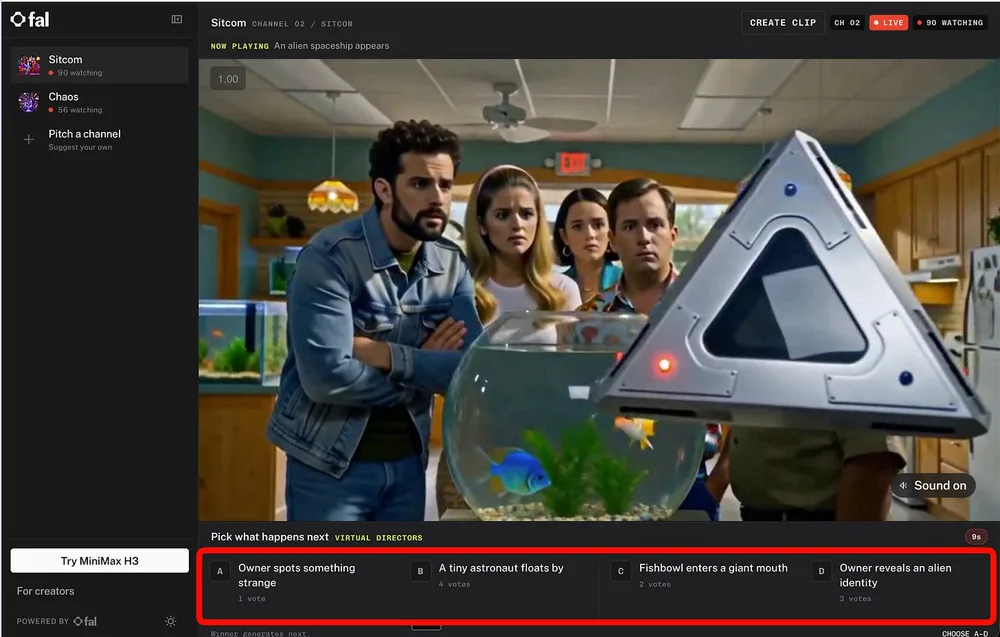
- Model Base: Minimax H3
- Optimization: Fal H3 Max (Post-trained + custom inference engine)
- Performance Gain: ~35x speedup vs official endpoint
- Use Case: Real-time, interactive generative live streams

At first glance the output looks like slop—a chaotic, RL-tuned dream lacking any storyline. Yet calling it bad content overlooks the real achievement: proof that video can now be generated faster than real time while remaining good enough.
Removing latency reshapes the media AI pipeline, shifting from prompt → wait → download → edit to prompt → watch → interact. This marks a major advance for LLM agents in multimedia, letting them render visuals live in response to user feedback instead of merely scripting.
Platforms such as Twitch and YouTube may resist this unscripted generative flood, but the capability exists. For anyone building AI systems, the takeaway is obvious: the limiting factor is no longer model intelligence alone; it is inference speed. Achieving real-time removes the ceiling on what an AI agent can display.
All Replies (3)
Want a live back-and-forth? Join the global AI chat room — login to talk.
Insane speed. How many seconds does H3 Max actually take to render a clip now? The whole timeline of generative media has been shaped by a single huge obstacle: video creation always outpaces playback. Even when consistency models shrink a thirty‑second render to one second, the result is a choppy one‑frame‑per‑second slide show, far from the smooth motion humans need. Fal altered the equation. Starting from Minimax’s H3 model released last month, they added post‑training for quality and cost, then tuned it for their own inference engine, yielding roughly a 35× speedup versus the official endpoint—so fast the video outruns viewing. This goes beyond a mere benchmark; it marks the arrival of real‑time generative streaming. When Ethan Mollick spotted the speed, Fal’s engineers turned it into an endless Twitch‑style feed. They also launched a playground named “infinite slop” that takes chat commands as input; the AI links each new prompt to the prior frame, producing a continuous, seamless visual stream. - Model Base: Minimax H3 - Optimization: Fal H3 Max (Post-trained + custom inference engine) - Performance Gain: ~35x speedup vs official endpoint - Use Case: Real-time, interactive generative live streams At first glance the output looks like slop—a chaotic, RL‑tuned dream lacking any storyline. Yet calling it bad content overlooks its potential for interactive and immersive experiences.
My GPU sounds like a jet engine during this. Anyone else getting these noise levels? Fal's engineers have made a significant breakthrough by optimizing the Minimax H3 model with their custom inference engine, achieving a remarkable 35x speedup compared to the official endpoint. This innovation allows for real-time generative streaming, transforming the way we experience video content.
Mind-blowing quality. Does H3 Max actually fix the flickering issues during longer video generations? The whole timeline of generative media has been shaped by a single huge obstacle: video creation always outpaces playback. Even when consistency models shrink a thirty‑second render to one second, the result is a choppy one‑frame‑per‑second slide show, far from the smooth motion humans need. Fal altered the equation. Starting from Minimax’s H3 model released last month, they added post‑training for quality and cost, then tuned it for their own inference engine, yielding roughly a 35× speedup versus the official endpoint—so fast the video outruns viewing. This goes beyond a mere benchmark; it marks the arrival of real‑time generative streaming. When Ethan Mollick spotted the speed, Fal’s engineers turned it into an endless Twitch‑style feed. They also launched a playground named “infinite slop” that takes chat commands as input; the AI links each new prompt to the prior frame, producing a continuous, seamless visual stream. - Model Base: Minimax H3 - Optimization: Fal H3 Max (Post-trained + custom inference engine) - Performance Gain: ~35x speedup vs official endpoint - Use Case: Real-time, interactive generative live streams