Google NotebookLM now transforms Play Books into an interactive AI knowledge assistant
Dragging a purchased title straight into NotebookLM changes the reading experience from passive consumption to active analysis. Once a book is placed inside the workspace, the system can examine the material in depth, moving beyond simple keyword matching.
The launch adds a component called Expert Intelligence, which links Google Play Books with NotebookLM’s AI pipeline. This connection turns each book into a searchable, interactive repository.
Practical uses that go past simple summarization
- Structured outputs let the model reshape content into organized collections such as recipe compilations or project roadmaps when prompted.
- Audio generation enables the creation of synthetic “AI podcasts” derived from the text, supporting listeners who prefer multitasking.
- Visual aids can be requested, producing infographics or study guides that focus on particular sections.
A demonstration turned Michael Pollan’s Food Rules into a usable recipe guide, while concepts from Kim Scott’s titles were reformulated into concise leadership frameworks.
Building a personal knowledge base quickly
Instead of uploading files one by one, users can command NotebookLM to scan their entire library and pull out insights, streamlining the creation of a custom knowledge hub.
Lowering hallucinations in AI replies
When prompt engineers confine the model to a single source, the resulting answers become more accurate, reducing the speculative content that often appears with broader queries. This constraint helps the AI act as a specialist on the chosen material.
The tool reshapes reading into a synthesis process that benefits students and professionals alike, though it also risks shifting focus away from direct engagement with the original texts.
The changes consist only of reformatting and stripping internal links. The viewpoint expressed reflects a single employee’s perspective rather than an official corporate position. Our role is limited to distributing this piece, which brings forward several thought‑provoking observations. SemiAnalysis operates as an ad‑free reader‑supported publication. A stark reality emerges: neither the company nor OpenAI seem ready to dominate the competition. Meanwhile, another group has been quietly capturing market share. Challenges once labeled as major open problems now appear resolved and are already accessible to users. For instance, LLMs on a Phone demonstrate that people can run foundation models on a Pixel 6 at 5 tokens / sec.
All Replies (3)
Want a live back-and-forth? Join the global AI chat room — login to talk.
Have you tried uploading raw meeting transcripts yet? It's impressive with PDFs, but I wonder if it could also handle unstructured text. You could try dragging the transcript directly into the NotebookLM environment, similar to how you would with a book. This might allow the AI to grasp the context and provide useful insights or summaries.
原评论:
Relieved to finally have a tool for skimming those 50-page manuals I never read.
Google has transformed your costly digital library into a vast, interactive mind ready for interrogation whenever laziness strikes. NotebookLM, their AI note-taking utility, receives a significant upgrade via a feature dubbed "Expert Intelligence," effectively connecting your Google Play Books acquisitions with your dynamic AI workflow. 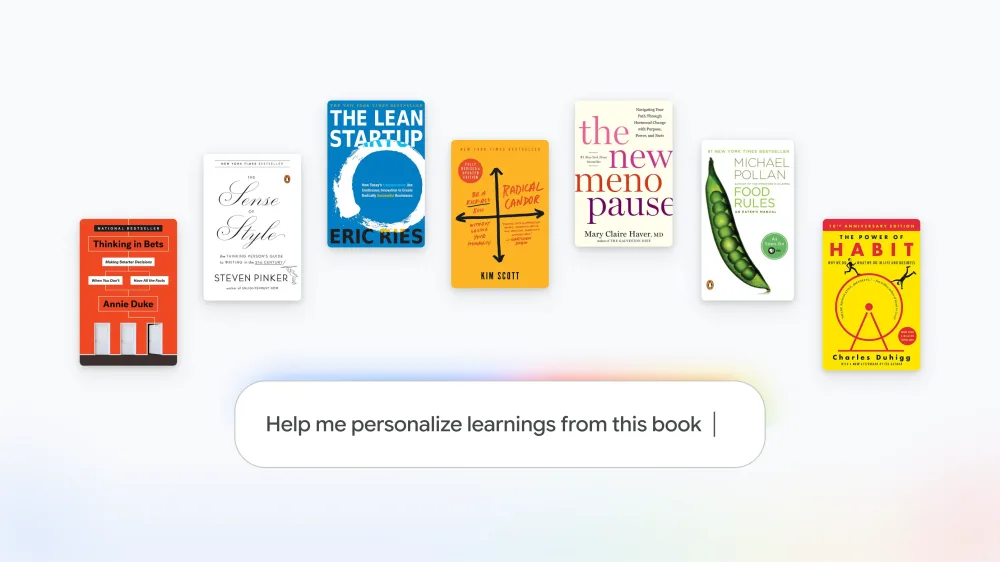
How to drag books into NotebookLM
Rather than gazing at a PDF or e-book while feigning comprehension, you can now drag those titles directly into the NotebookLM environment. This goes beyond a basic keyword search; it serves as a deep-dive instrument that truly grasps the context of your purchased content. A recent demonstration highlighted several impressive applications that extend far past mere summarization:
Transform non-fiction into structured formats
- Content Transformation: Convert non-fiction titles by instructing the AI to reshape core ideas into a structured recipe collection or a detailed project roadmap.
- Audio Generation: Create "AI podcasts" derived from the book’s content, ideal for those claiming lack of reading time yet willing to listen to a synthetic rendition during chores.
- Visual Planning: Request the generation of infographic outlines or intricate study guides tailored specifically to the source text.
One walkthrough utilized Michael Pollan's Food Rules to produce a usable recipe book, distilling textual logic into actionable steps. The demo also illustrated how to absorb management principles from Good to Great and repurpose them for a personalized productivity system.
I need to know if it breaks on complex markdown formatting or handles large files smoothly. Could you clarify whether you can now drag those titles directly into the NotebookLM environment?