Nvidia’s Groq 3 LPX boasts huge speed gains, yet the underlying calculations reveal hidden inefficiencies
Nvidia has moved its Groq 3 LPX inference chip into full manufacturing, advertising an astonishing 3,400 tokens per second on the Gemma 4 31B model. On the surface, this appears as a decisive triumph, particularly against Cerebras, which allegedly operates at one-quarter that pace. Yet, scrutinizing the hardware needed for such performance reveals that this "speed" edge resembles an efficiency shortfall more than a pure advantage.
This substantial throughput difference stems less from clock frequencies or architectural finesse than from sheer volume. Reaching the 3,400 tokens per second target demands a coordinated cluster of at least 64 accelerators from Nvidia. Conversely, Cerebras reportedly matches those results with merely one or two devices. Such a disparity drastically impacts physical space, energy usage, and overall ownership costs for anyone deploying an LLM agent or high-throughput system.
Real-world calculations pivot from simple "tokens per second" to "tokens per dollar per second" or "tokens per rack unit per second." Matching a single Cerebras wafer-scale engine requires 64 Nvidia chips, causing AI workflow complexity to spiral. You stop managing individual processors and start orchestrating a vast web of high-speed links, battling inter-node latency while synchronizing a large fleet of accelerators.
The scaling bottleneck for MoE models
Uncertainty persists regarding how these designs manage Mixture-of-Experts (MoE) models as they expand. MoE networks route distinct tokens to specific "experts." In Nvidia’s sprawling 64-chip layout, this routing turns into a significant networking challenge. Each time a token moves between chips to locate its expert, communication overhead accumulates.
If latency among those 64 accelerators becomes the limiting factor, the cited 3,400 tokens per second may only hold true under narrow, potentially impractical network scenarios. Further data is required to show how Groq 3 LPX handles:
- Inter-chip communication latency: What portion of speed vanishes when the model outgrows single-chip memory?
- Memory bandwidth vs. Compute: Does velocity stem from calculation power or weight movement capability?
- Power efficiency: Do the energy expenses of 64 chips cancel out speed advantages for providers?
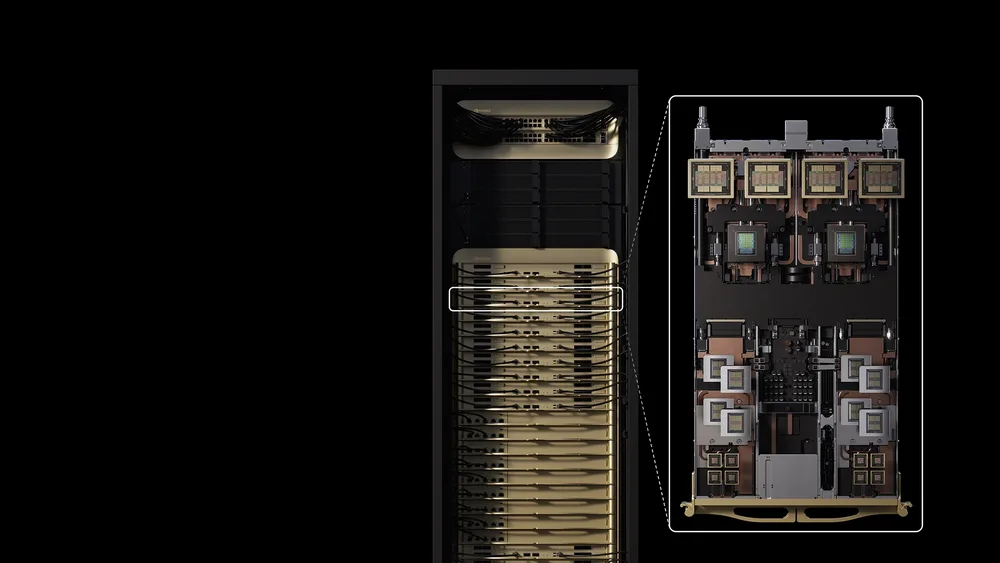
Nvidia’s heavy-handed strategy certainly impresses in raw output, but the sector is prioritizing efficiency. For newcomers seeking straightforward deployment or startups following practical scaling guides, a single-chip approach proves far more appealing than a sprawling cluster. We observe a clash between "distributed massive scale" and "monolithic architectural efficiency," where victory will depend on more than just token totals.
All Replies (3)
Want a live back-and-forth? Join the global AI chat room — login to talk.
The throughput numbers are impressive, but memory bandwidth still appears to be a critical bottleneck for Llama 3—especially when you consider how Nvidia’s Groq 3 LPX achieves its 3,400 tokens per second by relying on a massive cluster of 64 accelerators rather than architectural efficiency. While raw speed is eye-catching, the trade-off in hardware complexity, energy use, and cost per token suggests that memory bandwidth constraints remain a fundamental challenge for scaling inference effectively.
The benchmarks for larger context windows in MoE models are still limited, but Nvidia’s Groq 3 LPX chip, despite its claimed 3,400 tokens per second, actually requires a cluster of 64 accelerators to achieve that speed—far more than a single Cerebras wafer-scale engine—highlighting how hardware scaling often masks efficiency trade-offs. This makes real-world deployment far more complex than raw throughput suggests. Would anyone share insights on how MoE models scale beyond this hardware dependency?
This speed is insane, but how does the latency hold up with those long context windows? Nvidia has moved its Groq 3 LPX inference chip into full manufacturing, advertising an astonishing 3,400 tokens per second on the Gemma 4 31B model, requiring a coordinated cluster of at least 64 accelerators to reach that target. Matching a single Cerebras wafer-scale engine requires 64 Nvidia chips, causing AI workflow complexity to spiral. You stop managing individual processors and start orchestrating a vast web of high-speed links, battling inter-node latency while synchronizing a large fleet of accelerators. This large-scale requirement highlights the importance of efficient interconnects, as managing the latency of a 64-chip cluster is a significant challenge that could impact real-world performance despite the high throughput.