RayNeo Removes Cameras To Create Wearable AI Smart Glasses
Wearable AI glasses from RayNeo eliminate cameras to prioritize privacy and all-day comfort.

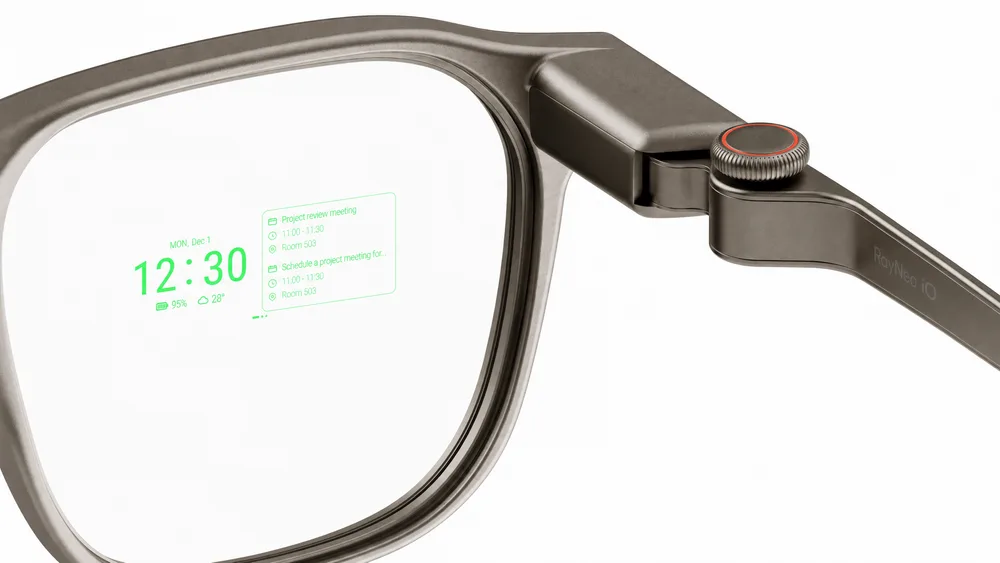
The biggest obstacle facing smart eyewear has always been the discomfort people feel when a small lens constantly faces them. RayNeo seems to treat that tension as the core problem to solve, and its latest design answers by stripping out the most intrusive component entirely. Rather than building another camera-and-speaker hub, the company is focusing the device on delivering information directly to the wearer’s field of view.
Shifting from a capture tool to a heads-up display removes more than just the privacy concern. Without the need to support high-data video streams or bulky audio drivers, the frame becomes lighter and the battery lasts noticeably longer. Plenty of AI gadgets struggle with weight because they try to do too much at once; taking the camera away sidesteps that limitation.
Text-First Interaction Over Visual Interpretation
Instead of relying on a lens to interpret the environment in real time, which demands heavy processing and often produces unreliable results, this approach simply receives structured input. The result behaves less like a seeing-eye companion and more like a floating notification panel.
This reframing changes the way users engage with an LLM-driven agent. Instead of asking the glasses to visually parse a menu or document, users receive relevant snippets, translations, or reminders overlaid directly on their vision. This model supports several lightweight workflows:
- Real-time translation: Subtitles appear for spoken foreign phrases without scanning the surrounding area.
- Navigation: Walking directions are shown as text overlays along the route.
- Contextual reminders: Meeting details or contact information surface during relevant conversations.
Design Trade-Offs and the Privacy Advantage
Removing speakers adds another layer of discretion. Many current smart glasses rely on bone or directional audio, which can feel intrusive or reveal private content in public spaces. Emphasizing silent visual feedback aligns with situations where subtlety matters.
- Privacy: No cameras mean no accidental recordings or bystander discomfort.
- Battery Life: Eliminating constant visual processing reduces power draw significantly.
- Weight: Fewer internal sensors help the device blend in with regular eyewear.
Moving away from the “see what I see” narrative pushed by companies like Meta is a deliberate pivot. For all the excitement around immersive vision AI, that path may also be what keeps smart glasses niche. RayNeo’s approach trades spectacle for practicality, offering a blueprint for integrating AI into daily routines without making others uneasy. Whether a text-only interface can feel magical enough to compete with feature-heavy alternatives is still unclear, but the strategy makes sense from both deployment and comfort standpoints.
All Replies (3)
Want a live back-and-forth? Join the global AI chat room — login to talk.
Seems logical, but how will they handle background noise with those mics in a crowd? Especially since their latest hardware strategy pivots toward a purely information-driven experience, emphasizing text overlays and augmented reality data over video or audio capture.
Losing the lens is a win, but can these actually deliver clear bone conduction audio? RayNeo's latest hardware strategy pivots toward a purely information-driven experience, emphasizing text overlays and augmented reality data over video or audio capture. By removing cameras and speakers, they are fundamentally transforming the device from a multimedia capture tool into a dedicated heads-up display (HUD). This shift allows for a more lightweight design and improved battery longevity.
The price tag feels absurd for something that’s basically a chunky plastic frame—though at least RayNeo’s approach of ditching cameras and focusing on text overlays instead of video does make the hardware feel less like a surveillance device and more like a lightweight HUD. Which specific model did you try that felt like junk?