GLM-5.2: High-Reasoning Performance vs. Token Verbosity

PromptCube Intermediate 7/27/2026 143 views 3 likes 2 min read

The recent release of GLM-5.2 has shifted the landscape for open-weight models, specifically regarding the balance between parameter efficiency and reasoning capabilities. While the industry often chases larger parameter counts to achieve better benchmarks, GLM-5.2 proves that architectural refinement and training data quality can drive significant gains without increasing the model's footprint.

GLM-5.2: High-Reasoning Performance vs. Token Verbosity

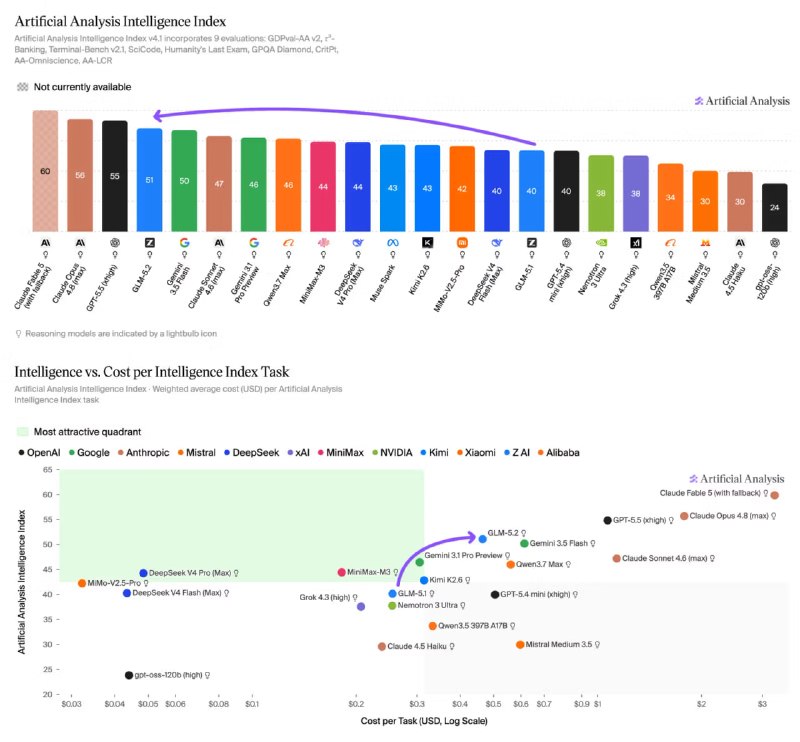
From a technical standpoint, the most striking detail is that GLM-5.2 maintains the exact same parameter split as version 5.1: 744B total parameters with 40B active parameters. Despite this static architecture, the model's score on the Artificial Analysis Intelligence Index jumped by 11 points, landing it at a score of 51. This suggests a massive leap in "intelligence per parameter," particularly in complex agentic workflows where it is now rivaling high-reasoning frontier models.

For those of us building RAG pipelines or long-form document processors, the 1 million token context window is a critical addition. When paired with the MIT license, this makes GLM-5.2 one of the most permissive and capable open-weight options currently available via third-party providers.

However, there is a significant trade-off that developers need to account for: extreme verbosity. The "intelligence" gain appears to be tied to a massive increase in internal reasoning tokens. Data indicates that the model outputs an average of 43k tokens per task. While this internal "chain-of-thought" process is likely what drives the higher benchmark scores, it creates a practical bottleneck in production environments.

If you are deploying this model, you need to consider two primary constraints:

1. Latency: Generating tens of thousands of internal tokens before reaching a final answer will significantly increase Time to First Token (TTFT) and overall request latency.
2. Cost: If you are using a provider that charges per token, the 43k token average per task could make your operational costs spiral quickly compared to more concise models.

To test the integration, most developers are accessing this via API providers since running a 744B MoE model locally requires substantial VRAM overhead. If you are monitoring your logs, keep a close eye on the output token counts; you'll likely see a surge in token usage that doesn't necessarily correlate with a longer final answer, but rather the model's internal deliberation.

In summary, GLM-5.2 is a powerhouse for complex reasoning and large-context tasks, and the MIT license removes the typical corporate friction associated with deployment. Just be prepared to optimize your token management strategies to handle the overhead that comes with its high-reasoning capabilities.

openaideepseek
Detailed breakdowns of putting AI to work are in a guide to making money with AI, with plenty of directly applicable cases.

All Replies (0)

No replies yet — be the first!

Write a Reply

Markdown supported