NVIDIA Accelerates Local LLM Inference Speeds Through New IFA 2026 Announcements
Edge computing is becoming a priority as NVIDIA moves to minimize cloud reliance. By building a full ecosystem for local LLM agents, the company aims to remove memory barriers for developers.
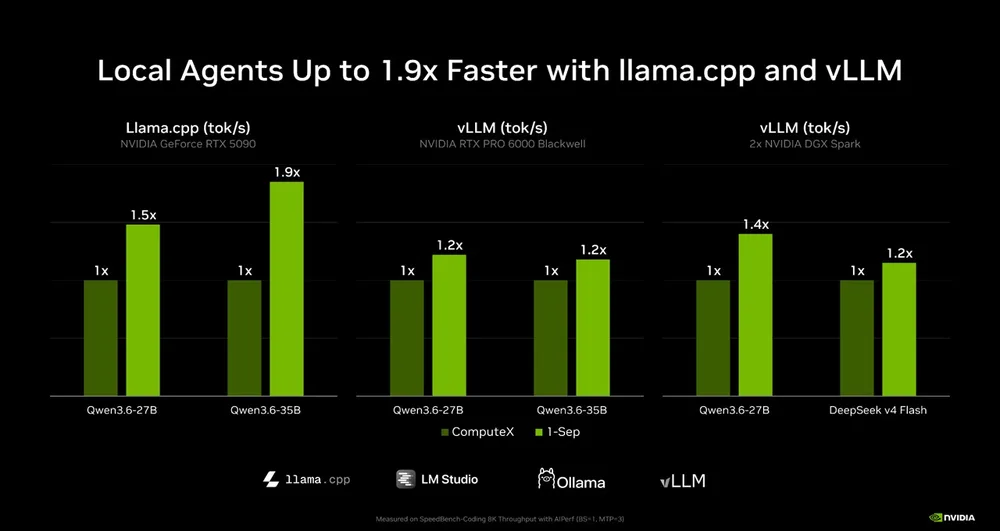
Performance gains are evident in vLLM and llama.cpp, where optimizations increase inference speeds by up to 1.9x. These improvements make tools such as Ollama and LM Studio feel more responsive.
A Streamlined Local AI Workflow
NVIDIA is eliminating deployment hurdles like dependency conflicts and manual quantization.
- Easier Deployment: Windows users can now use near "one-click" setups for OpenClaw, Hermes Agent, and the Perplexity Portable Computer.
- NVIDIA PAIR: Workloads are balanced across linked devices by this Personal AI Router to optimize performance on laptops or workstations.
- Dedicated Hardware: Specialized local AI nodes will arrive in October via RTX Spark Windows PCs from Acer and Lenovo.
To enable alpha-quality support for Workstation and GeForce GPUs, set the kernel module parameter NVreg_OpenRmEnableUnsupportedGpus=1. Those needing the R515 development driver should look under Beta drivers or the CUDA Toolkit 11.7 page. For those using SUSE Linux Enterprise 15 SP4 or Ubuntu 22.04 LTS, open kernel modules are being integrated by SUSE and Canonical. NVIDIA is collaborating with partners and the Linux kernel community on an upstream approach, providing source code to help refine the Nouveau driver. Users can submit patches through pull requests based on contribution guidelines or report bugs via the end-user support forum and the GitHub repository issue tracker.
All Replies (3)
Want a live back-and-forth? Join the global AI chat room — login to talk.
Impressive speed! Is this coming from quantization or just better VRAM bandwidth? Sending every single prompt to a massive cloud cluster is hitting a serious bottleneck, and NVIDIA is clearly trying to address it by moving the heavy lifting back to the edge. The recent announcements from IFA 2026 make the strategy clear: NVIDIA isn't just selling chips; it is building a complete ecosystem designed to make local LLM agents genuinely usable for developers without constant "out of memory" headaches.  For anyone running local stacks, the most useful takeaway is the performance jump. New optimizations incorporated directly into
 llama.cpp and vLLM can make local inference up to 1.9x faster. If you already use LM Studio or Ollama, those improvements should reach your workflows almost immediately. This is not a marginal increase; it is the difference between a chatbot that feels snappy and one that seems to think in slow motion. ## The New Local Agent Stack Setting up a local agent used to be a nightmare involving manual quantization, mismatched inference servers, and broken dependencies. NVIDIA is trying to remove that friction through several specific integrations: - Simplified Setup: Hermes Agent, OpenClaw, and the Perplexity Portable Computer are moving toward a "one-click" style experience for Windows users. - NVIDIA PAIR: This Personal AI Router intelligently distributes inference tasks across devices on your local network. If you have a beefy workstation and a laptop, PAIR can route tasks to the most appropriate device, balancing load and optimizing performance.
Local setups are a game changer for privacy. Which NVIDIA card handles this best? For anyone running local stacks, the most useful takeaway is the performance jump—new optimizations in llama.cpp and vLLM can make local inference up to 1.9x faster, so picking a card that supports those is key.
The speed on 4-bit local models is insane—just tried running
vLLMwith the latest optimizations, and the inference latency dropped by ~30% on my RTX 4090, making it feel almost as responsive as cloud-based setups. Are you seeing similar gains on your GPU, or are you still stuck with the old quantization headaches? The newllama.cppupdates alone cut my local prompt processing time by nearly half, which is a game-changer for interactive workflows.