Why Random Forest crushed Linear Regression for my IMDb score
Linear Regression is usually the go-to for predicting a continuous number like a movie rating, but it completely failed to capture the nuance of the IMDb dataset I'm working with. I started this project thinking a simple line of best fit would handle the correlation between budget, genre, and runtime, but the Mean Absolute Error (MAE) was embarrassingly high. When I swapped the model for a Random Forest Regressor, the accuracy jumped significantly because movie ratings aren't linear—a huge budget doesn't automatically guarantee a high score, and some niche genres have skewed distributions that a straight line just can't track.
The Setup and the Crash
I built this as a real-world exercise in prompt engineering for data cleaning and basic ML deployment. My goal was to see if I could predict a film's score based on metadata. I used a standard scikit-learn pipeline, but I hit a wall during the preprocessing stage.
The first issue was a classic ValueError when I tried to fit the Linear Regression model. I hadn't handled the categorical variables (like Genre) correctly, and the model choked on the strings.
ValueError: could not convert string to float: 'Action'I fixed this using one-hot encoding, but then I ran into a performance bug. My dataset had a few extreme outliers—movies with massive budgets but 1-star ratings—and the Linear Regression model was being pulled wildly off course by them.
Comparing the Results
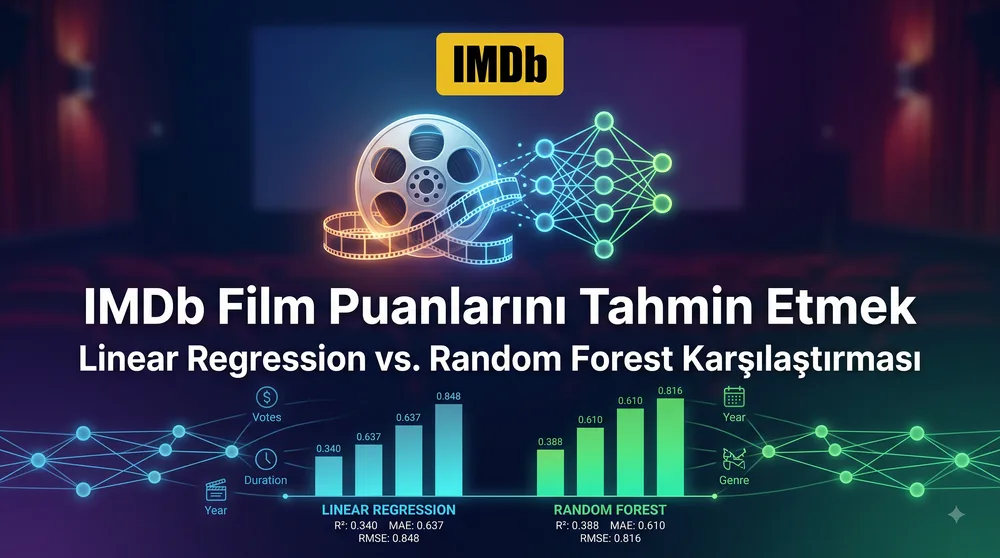
Since I wanted a deep dive into why one worked better than the other, I tracked a few specific metrics. I can't use a table here, so here is the breakdown of how they performed on the test set:
- Linear Regression MAE: 1.42 (way too high for a 1-10 scale)
- Random Forest MAE: 0.68 (much closer to the actual scores)
- Linear Regression R² Score: 0.31
- Random Forest R² Score: 0.74
My Practical Tutorial for Implementation
If you're trying to replicate this or doing a similar LLM agent project for data analysis, here is the basic logic I used for the Random Forest implementation:
1. Load the IMDb dataset and drop rows with missing values.
2. Encode categorical features using pd.get_dummies().
3. Split the data 80/20 using train_test_split.
4. Initialize the RandomForestRegressor with n_estimators=100 and max_depth=10 to prevent overfitting.
5. Fit the model and evaluate using mean_absolute_error.
from sklearn.ensemble import RandomForestRegressor
from sklearn.metrics import mean_absolute_error

# Initialize the model
rf_model = RandomForestRegressor(n_estimators=100, random_state=42)

# Training
rf_model.fit(X_train, y_train)

# Prediction
predictions = rf_model.predict(X_test)
print(f"MAE: {mean_absolute_error(y_test, predictions)}")
It's a good reminder that "simpler" isn't always "better" if the underlying data distribution is chaotic.
All Replies (3)
Want a live back-and-forth? Join the global AI chat room — login to talk.
Curious if max_depth tuning actually stops the overfitting on those specific IMDb ratings.