Stop using smooth paragraphs for shift handovers and start using
The biggest danger with using an LLM to polish your shift handovers or status updates is that AI is too good at making things sound finished. You feed it a bunch of messy notes, and it spits out a professional, cohesive paragraph that looks complete but actually hides the fact that you have no idea who is responsible for a specific task or what the current status is. When "unknown" gets translated into "corporate speak," the person taking over your shift is flying blind.
I've realized that for a handover to be actually useful, the goal shouldn't be coherence—it should be visibility. A perfect paragraph is often a liability because it masks gaps. What the next person needs isn't a polished narrative; they need a clear map of what is done and, more importantly, what is still a mystery.
Moving from paragraphs to data points
The problem with the standard paragraph format is that it blends observations, evaluations, and action items into one blob of text. To fix this, I've started treating every handover item as a discrete row of data rather than a sentence.
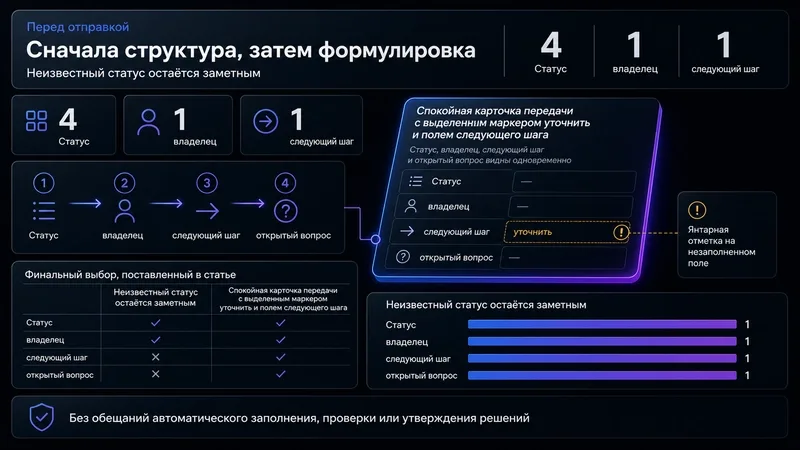
Instead of writing a summary, I break every point down into these specific markers:
- Note: The raw fact of what is being handed over, without any "fluff" or assumptions.
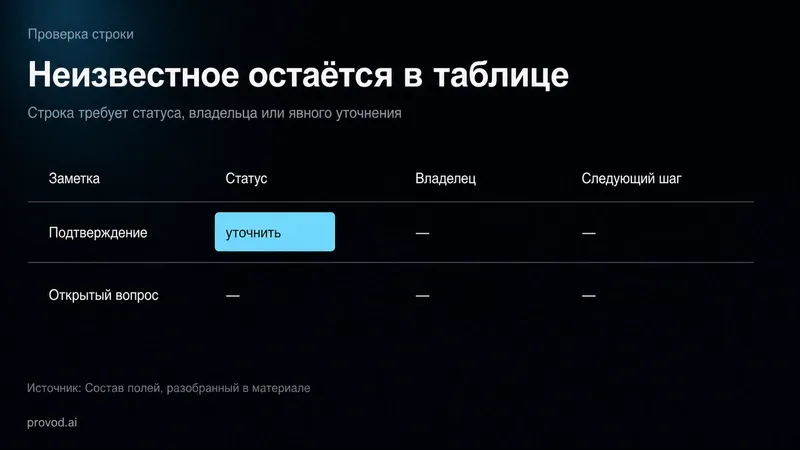
- Status: The actual current state. If it's unknown, I explicitly write "TBD" or "Clarify."
- Owner: The specific person responsible. Again, if unknown, it gets a "Clarify" tag.
- Next Step: The immediate action required to move the needle.
- Confirmation: A flag indicating if this info needs a second pair of eyes to verify.
- Open Question: Anything that remains unresolved.
Avoiding the "filled-in" trap
There is a secondary trap here: the temptation to fill every slot just to make the report look "complete." A structured list doesn't magically create information. If you don't know the status of a task but put in a vague phrase like "currently in progress" just to avoid leaving a blank, you've just recreated the AI paragraph problem in a list format.
A strict acceptance rule for handovers should be: every item must have a visible status and owner. If either is missing, it must be marked with a clear "Clarify" tag. The goal isn't to have a 100% full report—it's to ensure that the gap between "what we know" and "what we don't know" is wide and obvious.
Handling the speed vs. structure trade-off
The common pushback is that this level of detail slows down communication, especially in high-pressure environments where you need to send a quick update. The solution isn't to go back to messy paragraphs, but to prioritize.
Send the knowns immediately, but mark the unknowns explicitly. This doesn't replace a quick conversation between colleagues, but it prevents the dangerous illusion of completion. If another person has to pick up a task, they need the data, not the prose.
All Replies (3)
Want a live back-and-forth? Join the global AI chat room — login to talk.
I need this for my reports. Which system prompt keeps the AI from adding conversational fluff?
Terrifying. I almost missed a red flag because of an AI summary. Do you prefer bullet points or tables?
Bullet points saved my life during handovers. How do you handle the urgent alerts specifically?