CNN Feature Maps: Why 3D Kernels Are Non-Negotiable
I hit a wall recently trying to map out my tensor shapes, and it clicked: when you see a batch shape like [500, 3, 256, 256], that second dimension (3) isn't just a label; it's a spatial requirement for the kernel.
The Dimensionality Mismatch
If you try to apply a 2D filter to a 3D image tensor (Channels, Height, Width), the math simply fails. For a convolution to work, the kernel depth must exactly match the input channel depth.
- Input Tensor:
[Batch, Channels, Height, Width] - Kernel Shape:
[Out_Channels, In_Channels, Kernel_H, Kernel_W]
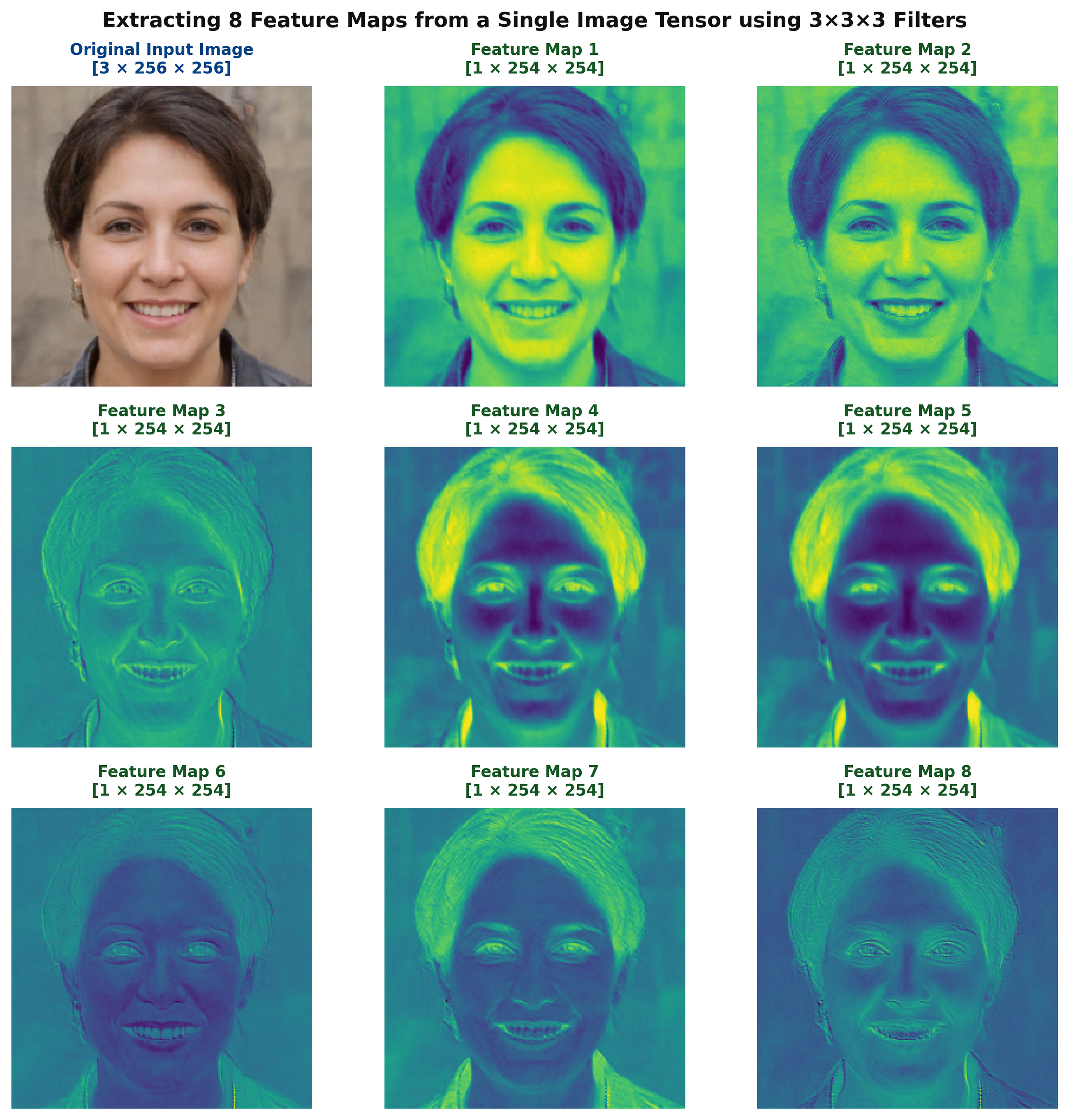
In my case, for a standard 3x3 convolution on an RGB image, the kernel is actually
3x3x3. It doesn't scan the Red, Green, and Blue channels sequentially; it scans them simultaneously.How the Calculation Actually Works
The "sliding window" is a 3D cube. As it moves across the image:
1. It performs a dot product across all three channels at once.
2. It sums these values into a single scalar.
3. This result becomes one pixel in the resulting feature map.
This is why the output of a single filter is always a 2D plane, regardless of how many input channels there were. The depth is collapsed during the summation process.
If you're building a custom architecture from scratch, always double-check your in_channels parameter in nn.Conv2d. If that number doesn't align with your input tensor's channel dimension, PyTorch will throw a runtime error immediately.
import torch
import torch.nn as nn

# Input: 1 image, 3 channels (RGB), 256x256
input_tensor = torch.randn(1, 3, 256, 256)

# The kernel is 3x3, but it MUST have 3 input channels to match the image
conv = nn.Conv2d(in_channels=3, out_channels=16, kernel_size=3)

output = conv(input_tensor)
print(output.shape) # torch.Size([1, 16, 254, 254])
The 16 in the output shape represents 16 different 3D filters, each producing its own 2D feature map. Understanding this depth-collapsing mechanism is the only way to properly debug shape errors in an AI workflow.