London NO2 Forecasting: Why ARIMA and Prophet Failed Me
Air quality data is notoriously messy, and trying to predict nitrogen dioxide levels in London proved that standard tutorials don't prepare you for real-world noise. My initial attempt at this project was a disaster because I treated the time series as a clean mathematical sequence rather than a chaotic set of sensor readings.
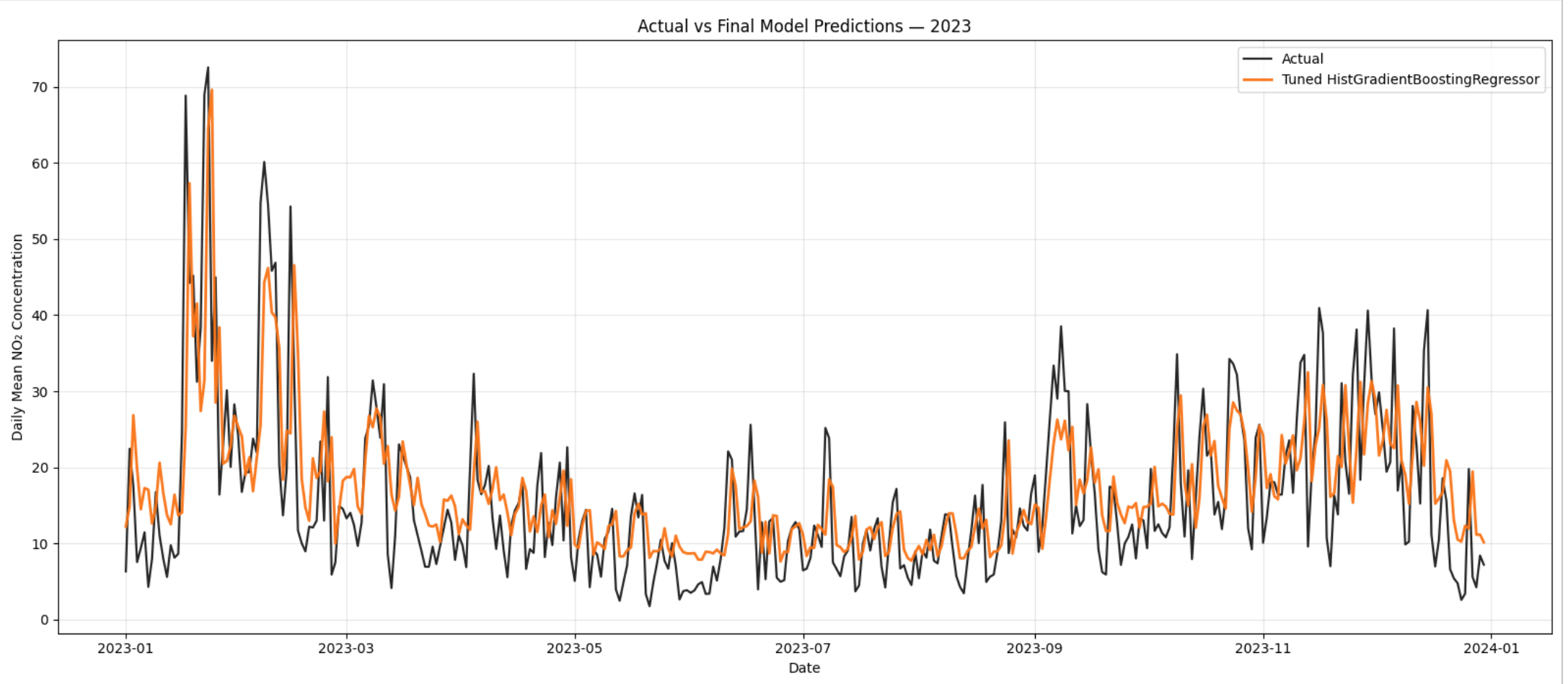
The first wall I hit was data cleaning. Real-world sensor data has gaps, outliers, and "flatlines" where the hardware just hangs. If you feed that directly into a model, your residuals will be a mess.
I started with ARIMA, but the stationarity requirements were a nightmare. I spent way too much time differencing the data just to get a stable p-value, and the results were still lagging behind the actual trends. Then I tried Prophet, thinking the additive model would handle the seasonality better, but it over-smoothed the peaks. I was getting a "pretty" curve that completely missed the actual pollution spikes I was trying to predict.
The turning point was realizing my validation strategy was broken. I was using random splits, which is a cardinal sin in time series. I had to implement time-based cross-validation (rolling window) to see how the model actually performed on "future" data it hadn't seen.
Here is the basic logic I used for the rolling window validation to stop the data leakage:
from sklearn.model_selection import TimeSeriesSplit

tscv = TimeSeriesSplit(n_splits=5)
for train_index, test_index in tscv.split(X):
    X_train, X_test = X[train_index], X[test_index]
    y_train, y_test = y[train_index], y[test_index]
    # Fit and evaluate model here
By switching to this AI workflow and focusing on the specific seasonality of urban traffic patterns rather than relying on "out-of-the-box" hyperparameters, the error rates finally dropped. It turns out that for environmental data, the preprocessing and the validation strategy matter more than the specific LLM agent or forecasting library you choose.
All Replies (3)
Prophet is a nightmare with outliers. Did you try switching to an LSTM or XGBoost for the weather data?
Rolling averages saved me from similar data spikes. Did that approach fail for your NO2 forecast too?
I'm curious if layering in wind speed or traffic patterns would fix those ARIMA errors. Has anyone tried that?