AI Agents: The New Era of Back-End Engineering
The shift from static REST APIs to autonomous AI agents is fundamentally changing how we build server-side logic. We are moving away from the "request-response" loop where the developer defines every single possible path, and moving toward a system where the backend can plan, decide, and execute actions independently to reach a goal.
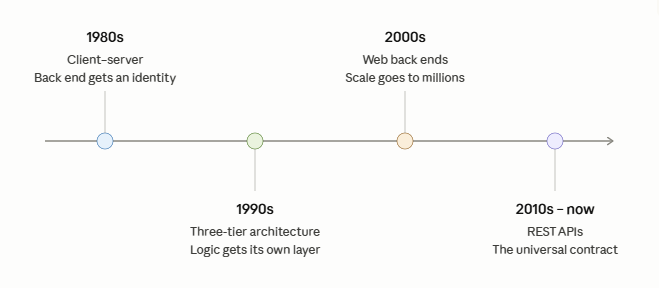
In a traditional setup, the backend is a passive servant: it waits for a specific endpoint call and returns data. With an LLM agent architecture, the backend becomes an active operator. Instead of calling /get-user-data and then /update-order-status, a frontend can send a high-level intent, and the agent determines which tools (APIs) it needs to trigger in what order to solve the problem.
For anyone looking to build this from scratch, the architectural shift usually looks like this:
1. Tool Definition: Instead of just writing endpoints, you create "tools" with clear semantic descriptions so the LLM knows when to use them.
2. Reasoning Loop: Implementing a framework (like ReAct or LangGraph) that allows the agent to think, act, and observe the result before taking the next step.
3. State Management: Moving from stateless requests to maintaining a "session memory" so the agent remembers what it tried and why it failed.
This is a massive leap for AI workflow automation. It turns the backend into a reasoning engine rather than just a data pipeline. While it adds complexity in terms of latency and non-deterministic outputs, the ability to handle complex, multi-step tasks without hard-coding every edge case is a huge win.
If you're already comfortable with prompt engineering, transitioning to building these agents is the logical next step for modern deployment.
LangGraph is a nightmare for state transitions. How are you handling the logic flow?