Claude vs GPT vs Gemini: 2026 API Comparison
The Actual Context Window Reality
There is a lot of noise around context limits. To be precise: Gemini 3.1 Pro is capped at 1M tokens, not 2M. Furthermore, having a large window doesn't mean it's cheap to use. Google implements a pricing jump for Gemini Pro once you exceed 200K tokens, meaning your cost per token effectively increases as your prompt grows.
In contrast, Anthropic's current lineup (Opus 4.8, Sonnet 5, and Fable 5) maintains a flat rate across their 1M token window. If you are pushing massive datasets into a prompt without a RAG layer, Claude is currently the more predictable budget option.
Model Tier Breakdown
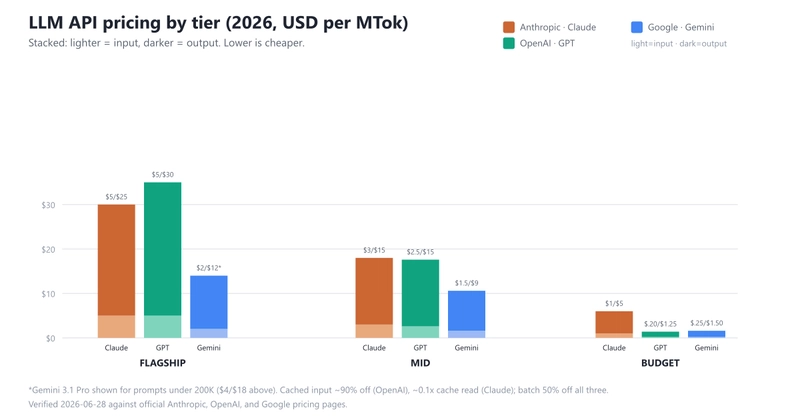
The providers have settled into a three-tier hierarchy: the "Reasoning Flagship," the "Balanced Workhorse," and the "Budget/High-Volume" model.
- Anthropic: Fable 5 is the current ceiling for capability (released June 9, 2026), priced at $10/MTok input and $50/MTok output. Below that, Sonnet 5 handles the bulk of production workloads, and Haiku 4.5 serves the low-latency needs.
- OpenAI: GPT-5.5 is the flagship, with a "Pro" variant for high-complexity reasoning. The 5.4 family (including Mini and Nano) handles the mid-to-low tiers.
- Google: Gemini 3.1 Pro Preview is the top end, while 3.5 Flash and 3.1 Flash-Lite compete on speed and cost.
Performance and Pricing Metrics
When calculating your AI workflow costs, don't just look at the headline input price. Caching and output limits are where the real variance lies.
- Caching Costs: OpenAI offers a clean ~90% discount on cached input tokens. Google, however, uses a storage-based model ($1.00 per 1M tokens per hour), which changes the math entirely depending on how often your cache is hit.
- Output Limits: Fable 5 supports up to 128K max output tokens, which is critical for long-form code generation or document synthesis.
- Context Windows:
- GPT-5.5 / GPT-5.4: ~1.05M tokens
- Gemini 3.1 Pro / 3.5 Flash: 1M tokens
- Claude Haiku 4.5: 200K tokens
- GPT-5.4-Nano: 400K tokens
Deployment Considerations
If you're building an LLM agent, the choice depends on your specific bottleneck. For high-throughput, low-latency tasks, the "Nano" or "Lite" models are the only viable path to keep margins healthy. However, for complex prompt engineering where reasoning depth is non-negotiable, Fable 5 or GPT-5.5 Pro are the current benchmarks.
For those implementing context caching to reduce latency, I recommend testing the hit rate versus the cost of Google's hourly storage fees. In many real-world scenarios, OpenAI's percentage-based discount is easier to forecast for monthly budgeting.
If you are starting a project from scratch, I suggest starting with a mid-tier model like Sonnet 5 or GPT-5.4. They provide the best balance of "intelligence per dollar" before you decide if you need to scale up to a flagship or down to a budget model for deployment.