NumPy: My first real encounter with array computing
Switching from standard Python lists to NumPy arrays feels like moving from a bicycle to a jet engine once you hit a certain data threshold. I've spent the last few days wrestling with basic Python logic, but getting into
Next
Overbooked Flights: The Data Science Paradox →
numpy is where the actual "data science" part of the journey seems to start.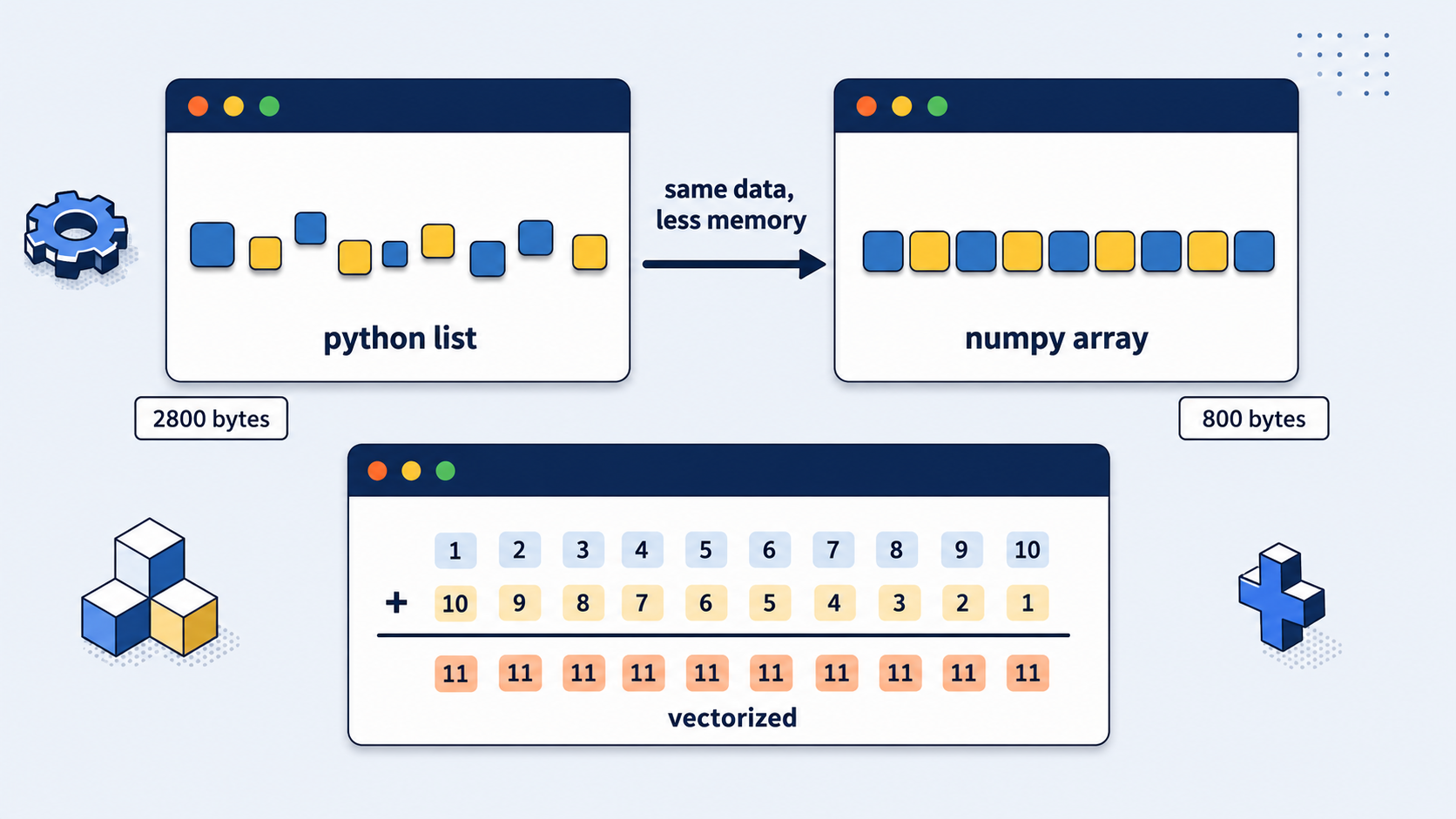
The immediate realization is how much cleaner the syntax is for mathematical operations. Instead of writing clunky loops to perform calculations across a list, you just apply the operation to the whole array. It's essentially vectorization in action, and it makes the code significantly more readable.
For anyone just starting a hands-on guide to data manipulation, here is the basic setup I'm using to test these concepts:
import numpy as np

# Creating a simple array to test element-wise operations
data = np.array([10, 20, 30, 40])
result = data * 2
print(result) # Output: [20 40 60 80]
I'm still wrapping my head around broadcasting—the way NumPy handles arrays of different shapes—but the performance jump is obvious even in these tiny examples. If you're coming from a pure Python background, the shift in mental model from "iterate through elements" to "operate on the entire tensor" is the biggest hurdle.
Free AI toolbox — all free to use
All Replies (3)
C
CyberSmith
Advanced
7/24/2026
Did you try broadcasting yet? It's a game changer for avoiding those loops.
0
G
Wait until you hit a memory leak. Spent three days debugging a shape mismatch that broke everything. Overrated.
0
N
Vectorization is where it really shines. Makes the code way cleaner than nested for loops.
0