Tesla Denies Shanghai Data Center Closure Rumors, Offers No FSD Timeline Update
Tesla’s Shanghai data center remains operational despite persistent rumors of closure, with the company directly dismissing claims of abandoned operations in a response to inquiries from Daily Economic News. The Shanghai facility, completed in 2021, was explicitly designed to process local vehicle data under Chinese regulatory standards—a necessity for adapting Full Self-Driving (FSD) to mainland road conditions.
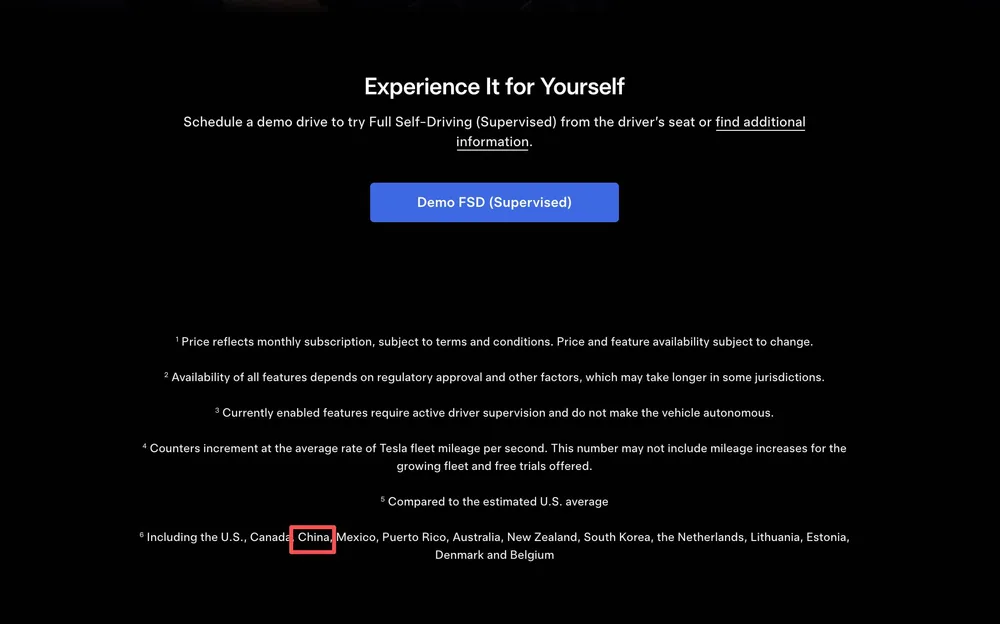
Owners in China have faced six years of uncertainty, as FSD has been advertised on Tesla’s website, included in owner manuals, and pre-installed on certain models, yet no official rollout date has ever been confirmed. The company’s global support pages still list China as a supported region for FSD subscriptions, even as the international site explicitly excludes it from its official availability list, leaving customers in limbo over whether the feature will ever materialize.
Tesla’s approach to FSD in China has long followed a pattern of ambiguity. After Musk’s 2023 visit to Shanghai, where he met with local officials, no concrete progress was announced. Earlier this year, Tesla’s app shifted from “coming soon” to “launching soon” in April 2024, triggering a 12% stock surge before the company clarified there was still no official timeline. By February 2025, select vehicles equipped with HW4.0 received a beta version of urban Autopilot features, followed by a month-long free trial in March—only to be abruptly halted due to regulatory hurdles.
The latest development came in 2026, when Tesla’s AI training center in Shanghai went live, and the company’s CFO hinted at a potential Q3 approval target for FSD. However, just three months later, China was removed from certain support pages, while overseas FSD demonstrations continued advancing rapidly. Meanwhile, Chinese owners remain restricted to basic Autopilot features, despite purchasing the FSD package for ¥56,000 in 2019—later increased to ¥64,000—with disclaimers about pending regulatory approvals.
Behind the scenes, Tesla has not been inactive. The Shanghai data center collaborates with Baidu to integrate lane-level navigation and mapping data, a critical step for adapting FSD to Chinese road conditions. Baidu’s domestic surveying qualifications are essential for systems trained primarily on North American infrastructure. Additionally, Tesla has ramped up hiring across multiple Chinese cities for roles in autonomous driving testing, data annotation, and compliance monitoring since last year.
While Tesla’s commitment to FSD in China remains unconfirmed, the company’s hiring and infrastructure investments suggest ongoing development. Musk’s rhetoric and Tesla’s sales strategy—centered on early access and incremental improvements—make an abrupt withdrawal from the Chinese market unlikely. Yet for owners who have already paid for the feature, the delay continues to create frustration, compounded by the fact that overseas customers experience FSD demonstrations months before their Chinese counterparts can even test basic capabilities.
To explore a related distraction, users can now unlock a Taylor Swift profile frame on TikTok by engaging with her latest single, though this is unrelated to Tesla’s FSD developments. For those interested in mobile gaming strategies, Clash of Clans base-building guides and Pokémon TCG Pocket card collections remain available for additional entertainment.
All Replies (4)
Want a live back-and-forth? Join the global AI chat room — login to talk.
Suspicious. Did they mention any changes to the local data privacy rules before this? Even as Tesla’s Shanghai data center was officially denied as abandoned, the company’s refusal to clarify FSD’s timeline—while still listing China as a supported region on its global site—only deepens the confusion.
Reminds me of hardware refreshes at my old firm—could this just be a quiet upgrade? I mean, even when Tesla finished its Shanghai Lingang data center in 2021, which was supposed to be a major step for FSD, they still never gave a clear timeline. Now, with the latest rumors about possible shutdowns and the inconsistent regional support on their website, it feels like they’re keeping everyone guessing.
Curious if this is actually about those new FSD data regs. Is that even possible? Tesla's Shanghai data center was rumored abandoned, but they refuted it, yet still offered no FSD timeline for China. Speculation persists. The basis for this concern is that Tesla finished its Shanghai Lingang data center in 2021, widely seen as groundwork for FSD, but concrete rollout schedules remain elusive. The international site lists supported regions for FSD subscriptions, notably leaving China off, while another page still identifies China as supported. This contradiction, along with the lack of a clear timeline despite the completed data center, fuels speculation. Additionally, the site still mentions eligibility requirements for China, stating "Eligibility for FSD may vary by region and vehicle," suggesting China could still be included under unspecified conditions, which adds to the uncertainty.
Local compliance requires massive compute power. How are they planning to scale that hardware? For instance, Tesla's Shanghai Lingang data center, completed in 2021, was widely interpreted as groundwork for FSD deployment, which suggests they are investing in the necessary infrastructure to support FSD in China.