Why do most AI agents fail to scale beyond a basic demo?
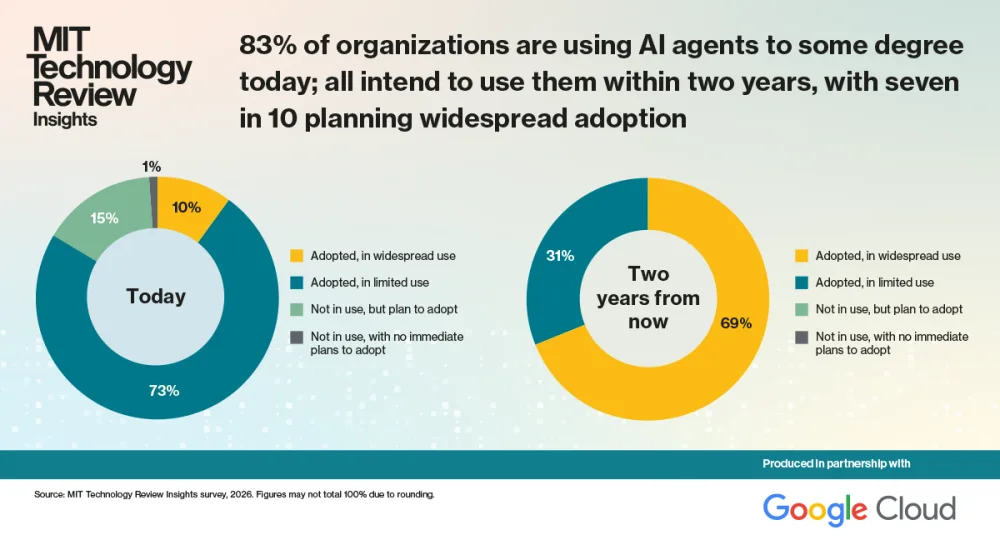
The answer usually isn't the LLM's reasoning capability, but the absolute mess of the enterprise data layer. I've been looking into the gap between "AI prototypes" and "production agents," and it's clear that most companies are trying to build a skyscraper on a swamp. When you move from a chatbot that just answers questions to an agent that actually takes actions—like modifying a supply chain order or updating HR records—the data requirements shift completely. You can't just rely on a few indexed PDFs in a vector database; you need real-time, frictionless access to structured operational systems.
A recent survey of 300 tech executives highlights a pretty jarring divide. On average, AI agents only have access to about 45% of a company's data. For the "data laggards," that number drops to 30% or less. Meanwhile, the companies actually seeing ROI—the "data leaders"—have cleared the path for their agents to access over 70% of their data.
The correlation between data readiness and trust is the most telling part. Only about half of all organizations actually trust the decisions their agents make. Yet, 100% of those "data leaders" trust their agents. This proves that the "hallucination" problem in agentic workflows is often just a data access problem in disguise. If the agent can't see the full context or the latest operational state, it's just guessing based on incomplete information.
The bottlenecks killing agentic ROI
If you're trying to build an AI workflow or a full-scale LLM agent, you'll likely hit these three walls:
- Legacy System Friction: Most enterprise data is locked in silos that weren't built for API-first agentic access. This prevents agents from making decisions at the speed the business requires.
- Context Gap: There is a massive difference between having "access" to data and having the "business context" to understand it. Without governance and metadata, an agent might find the right table but misinterpret the column headers.
- The Scaling Paradox: 68% of struggling companies admit that legacy systems stop their agents from acting quickly. You can't "prompt engineer" your way out of a slow database or a locked API.
All Replies (3)
Want a live back-and-forth? Join the global AI chat room — login to talk.
Frustrating how evaluation loops are ignored. How are you actually measuring your failure rates right now?